

Last week, we talked about why a change in condition does not automatically mean a resident has to leave an assisted living facility.
But that leads to the next question I hear all the time:
“Okay, Carline… so when DOES the resident actually have to move?”
This is where ALF owners, administrators, and families need to understand the difference between:
A resident needing more help
and
A resident no longer being appropriate for that particular ALF.
Those are not always the same thing.
Under Florida law, assisted living facilities are responsible for continually determining whether a resident remains appropriate for the facility.
And sometimes, yes — a resident's condition can reach the point where remaining in that ALF is no longer appropriate.
But the decision should be based on the resident's actual needs, the services available, and what the facility is legally permitted and capable of providing — not simply on the fact that the resident has gotten older, weaker, or needs more assistance.
The Real Question Is: Can This Facility Still Meet the Resident's Needs?
Florida Statute 429.26 places responsibility on the ALF owner or administrator to determine whether a resident remains appropriate for continued residency.
That determination considers things such as:
-
The resident's current strengths, needs, and preferences
-
The resident's medical condition
-
The care and services the facility provides or arranges
-
Services that may be provided by outside licensed providers
-
The type of ALF license the facility holds
-
Any limitations under Florida law or rule
So when a resident's condition changes, the question should not immediately be:
“Do they have to move?”
The better question is:
“Can we safely and legally continue meeting this resident's needs here?”
That distinction matters.
When a Resident May No Longer Be Appropriate for the ALF
There are situations where an assisted living facility may determine that it can no longer safely or legally meet a resident's needs.
For example, the resident's condition may have progressed to a level of care that exceeds what the facility can provide under its license.
A resident may also develop needs that require services, supervision, or nursing care that the facility is not equipped or licensed to provide.
Florida's assisted living rules are clear: if the resident no longer meets continued-residency criteria or the facility is unable to meet the resident's needs, the resident must be discharged according to Florida's resident-rights requirements.
But notice something important:
The rule does not simply say, “The resident's condition changed, so they must leave.”
There has to be an evaluation of whether the resident can appropriately remain.
Needing More Help Does NOT Automatically Mean “Nursing Home”
This is one of the biggest misconceptions I see.
A resident can begin needing additional assistance and still potentially remain in assisted living.
Depending on the circumstances, an ALF may be able to coordinate additional services through:
-
Home health
-
Hospice
-
Physical or occupational therapy
-
Outside health care providers
-
Assistive devices
-
Additional permitted services within the facility's license
Florida law specifically allows an ALF, under certain circumstances, to retain residents receiving health care services that can appropriately be provided in a residential setting.
Residents using assistive devices may also be retained when their other needs remain appropriate for the facility.
And hospice deserves special attention.
A resident receiving hospice services may be able to remain in the ALF when the required conditions are met, including coordination between the facility, hospice provider, physician, and resident.
Hospice does not automatically mean the resident must leave the ALF.
Your ALF License Matters
This is why ALF owners need to understand exactly what their license allows.
A Standard ALF, an ALF with Limited Nursing Services (LNS), and an ALF with Extended Congregate Care (ECC) do not necessarily have the same scope when a resident's needs increase.
Your license affects what services can be provided and, ultimately, which residents you may be able to retain.
That is also why accepting residents simply because you have an empty bed can become an expensive mistake.
Before admission, you should already be asking:
Can we meet this person's needs today?
And just as importantly:
If their condition progresses, what can our facility legally provide?
Filling a bed without understanding the resident's care needs and your license limitations can create a compliance problem later.
The 1823 Still Matters — But It Is Only Part of the Picture
Last week, we talked about the AHCA Form 1823.
Remember:
A significant change in a resident's condition may require reassessment and an updated 1823.
But an updated 1823 is not simply paperwork.
It gives the facility information needed to evaluate whether:
-
The resident's needs have changed
-
Additional services are necessary
-
The resident still meets continued-residency criteria
-
Outside providers should become involved
-
The facility can continue providing appropriate care
That is why owners and administrators should never look at the 1823 as something that gets filed away and forgotten.
It should help you make care and compliance decisions.
Owners: Do Not Wait Until There Is a Crisis
One of the worst times to figure out whether you can retain a resident is after something has already gone wrong.
If you begin noticing a decline, increased assistance needs, repeated falls, changes in cognition, medication changes, new diagnoses, or other significant changes, start evaluating early.
Document what you're seeing.
Communicate with the appropriate health care provider.
Communicate with the resident and family or representative.
Determine whether additional services can safely support the resident.
And determine whether those services fit within the scope of your facility's license.
The goal is not simply to keep the bed occupied.
The goal is to provide the resident with the right care, in the right setting, within the law.
If You're a Family, Ask These Questions Before Agreeing to a Move
If an ALF tells you that your loved one may need to relocate, it is okay to ask questions.
Ask:
-
What specifically has changed?
-
What need can the facility no longer meet?
-
Has the resident been reassessed?
-
Is there an updated 1823?
-
Could additional home health, hospice, therapy, or another outside service help?
-
Is the issue related to the facility's particular license?
-
What level of care does the resident now require?
Sometimes relocation truly is necessary.
But families deserve to understand why.
For ALF Owners: This Is a Compliance Decision, Not Just a Business Decision
There is another side to this conversation that owners need to hear.
Keeping a resident who has become inappropriate for your facility can create just as much risk as prematurely telling someone they have to leave.
You have a responsibility to know:
Who you can admit.
Who you can retain.
What your license allows.
When additional services can be brought in.
And when the resident truly needs a different level of care.
Those decisions affect resident safety, your survey results, your liability, and ultimately your license.
When in doubt, don't guess.
Go back to the resident's assessment, Florida's continued-residency requirements, your license type, your policies, and the services you can actually provide.
What to Do This Week
If you own or operate an ALF, take 15 minutes this week and review several resident files.
For each resident, ask:
-
Is the most recent 1823 still consistent with what we're seeing today?
-
Has there been a significant change?
-
Are we documenting changes in condition?
-
Are the resident's current services sufficient?
-
Do we understand what our license permits us to provide?
-
Are outside providers involved where appropriate?
-
Could we clearly explain why this resident remains appropriate for our facility?
You don't want to discover the answer to those questions for the first time when AHCA is standing in your building.
Watch This Week on YouTube
New videos go up every week on my channel, all free and all Florida-specific. Here's where to start:
- Is Owning an Assisted Living Facility Profitable? Real Numbers, new this week: the occupancy math at 70 percent versus 90 percent, and the mistake almost every new owner makes
- Opening an Assisted Living Facility in Florida? Start Here, a map of the channel with a path for future owners, operators, investors and families
- Adult Family Care Home vs Assisted Living: Key Differences Every Caregiver Must Know
- Working with Hospice: A Collaborative Approach
Subscribe to the channel so the next one finds you.
From the Conference Program: Learn the Decisions That Affect Your ALF After You Open
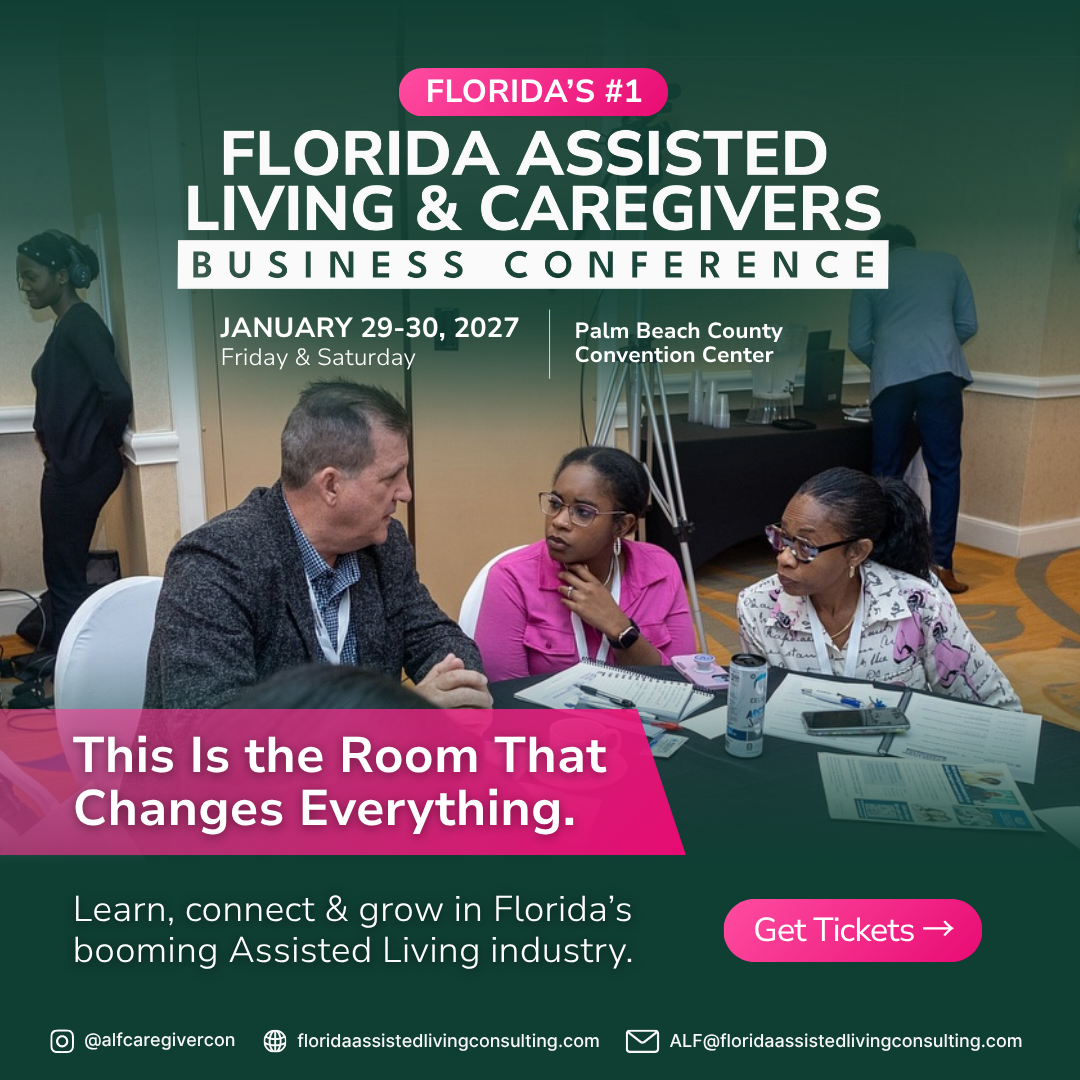
Opening the doors is one milestone.
Operating correctly after those doors open is where the real work begins.
At the 2027 Florida Assisted Living & Caregivers Conference, we're bringing ALF owners, administrators, caregivers, health care professionals, attorneys, service providers, investors, and industry experts into one room.
📅 January 29–30, 2027
📍 Palm Beach County Convention Center — West Palm Beach, Florida
We'll be talking about the issues owners actually face after licensing — compliance, resident care, operations, staffing, legal issues, growth, marketing, resources, and the relationships you need around you.
This is not just about opening an ALF.
It's about learning how to operate one successfully.
And if you are still working toward opening your facility, you need to hear these conversations before you become responsible for residents.
Get in the room. The right room.
Before You Go
Here's what I want you to remember from this two-part conversation:
A resident's needs changing does not automatically mean they have to move.
But it also does not mean an ALF can keep every resident indefinitely.
The real question is whether the facility can safely, appropriately, and legally meet that resident's needs.
That's why knowing your regulations matters.
That's why knowing your license matters.
And that's why good ALF ownership requires much more than filling beds.
We're caring for people.
I'll see you next week.
With prosperity,
Carline Cadet Francois
CEO, Florida Assisted Living Consulting LLC

Responses