

"Mom's needs have changed. Does she have to move?"
Families ask it on move-in day. Owners get the call at nine at night. And the answer most people assume, yes, is often wrong.
Florida's assisted living law is built around aging in place. The owners who send residents away too soon usually aren't being careless. Nobody ever showed them the tools they already have.
Here they are.
What the Law Requires Before Anyone Moves
Under section 429.28 of the Florida Statutes, a resident has the right to:
- At least 45 days' notice of relocation or termination of residency.
- The reasons in writing, given to the resident or their legal representative.
- A notice that says they may contact the State Long-Term Care Ombudsman Program, with the program's statewide toll-free number on it.
There are only two exceptions to the 45 days:
- A physician certifies that, for medical reasons, the resident needs an emergency relocation to a facility providing a more skilled level of care.
- The resident engages in a pattern of conduct that is harmful or offensive to other residents.
And one line owners should know cold: a facility may not serve notice in retaliation because a resident exercised a right or reported a violation.
A Change in Condition Starts With the 1823, Not a Notice
- A significant change in condition calls for a new 1823 health assessment. That's the first step, before anyone talks about moving.
- The administrator decides whether the resident is still appropriate for your facility, not the form. The 1823 informs that decision. It doesn't make it.
- The decision depends on what your license allows. Which brings us to the part most owners never planned for.
The Licenses That Let Residents Stay
Add the limited nursing license. With a limited nursing services (LNS) license, the facility, or its nurse, can provide limited nursing services: routine dressings, care of casts, braces and splints, and care for residents on hospice. These are done by a licensed nurse, never by unlicensed staff. A registered nurse visits at least once a year.
If you're an LPN or RN who wants to keep practicing, this is how you use those credentials inside your own facility. Many nurses open a facility without ever knowing it.
Extended congregate care (ECC) exists for exactly this question. The statute says its primary purpose is "to allow residents the option of remaining in a familiar setting" as they become more impaired, and ECC facilities must adopt policies "to permit residents to age in place."
- Eligibility: licensed for 2 years (or a provisional ECC license of no more than 6 months), with no class I or II violations and no pattern of class III violations in the past 2 years.
- Oversight: an AHCA nurse visits at least twice a year.
- Bedridden limits: 7 days under a standard license, 14 days under ECC.
Hospice. A resident who wouldn't otherwise meet admissions requirements can stay with the help of hospice. Hospice determines what's what. I had a resident on hospice pass away in my own facility, and I want every operator to know this: you do not have to send people away.
Aging in place has limits, and they run both ways. If a resident needs more than your license allows, keeping them because you don't want to say goodbye is a risk to them and to your license. The administrator decides, and any move follows the notice rules above.
If You're a Family Choosing a Facility
Ask these before move-in, not after a hospital stay:
- Do you hold a limited nursing services license? An ECC license?
- Do you work with hospice?
- What happens, step by step, if my parent's needs change?
- Who makes that call, and how much notice will we get? The answer should be at least 45 days, outside the two exceptions above.
What to Do This Week
- Pull the 1823 for every resident whose condition has changed since their last assessment.
- Read your relocation notice template. Does it give 45 days, state the reasons in writing, and include the Ombudsman statement with the toll-free number?
- Look at what you're turning away. If residents are leaving for care a limited nursing license would cover, that's revenue and relationships walking out the door.
- Build your hospice relationship now, before a family needs it at nine at night.
- Licensed 2 years with a clean record? Check whether you qualify for ECC.
Watch This Week on YouTube
New videos go up every week on my channel, all free and all Florida-specific. Here's where to start:
- Is Owning an Assisted Living Facility Profitable? Real Numbers, new this week: the occupancy math at 70 percent versus 90 percent, and the mistake almost every new owner makes
- Opening an Assisted Living Facility in Florida? Start Here, a map of the channel with a path for future owners, operators, investors and families
- Adult Family Care Home vs Assisted Living: Key Differences Every Caregiver Must Know
- Working with Hospice: A Collaborative Approach
Subscribe to the channel so the next one finds you.
From the Conference Program: ALF, Adult Family-Care Home or APD Group Home?
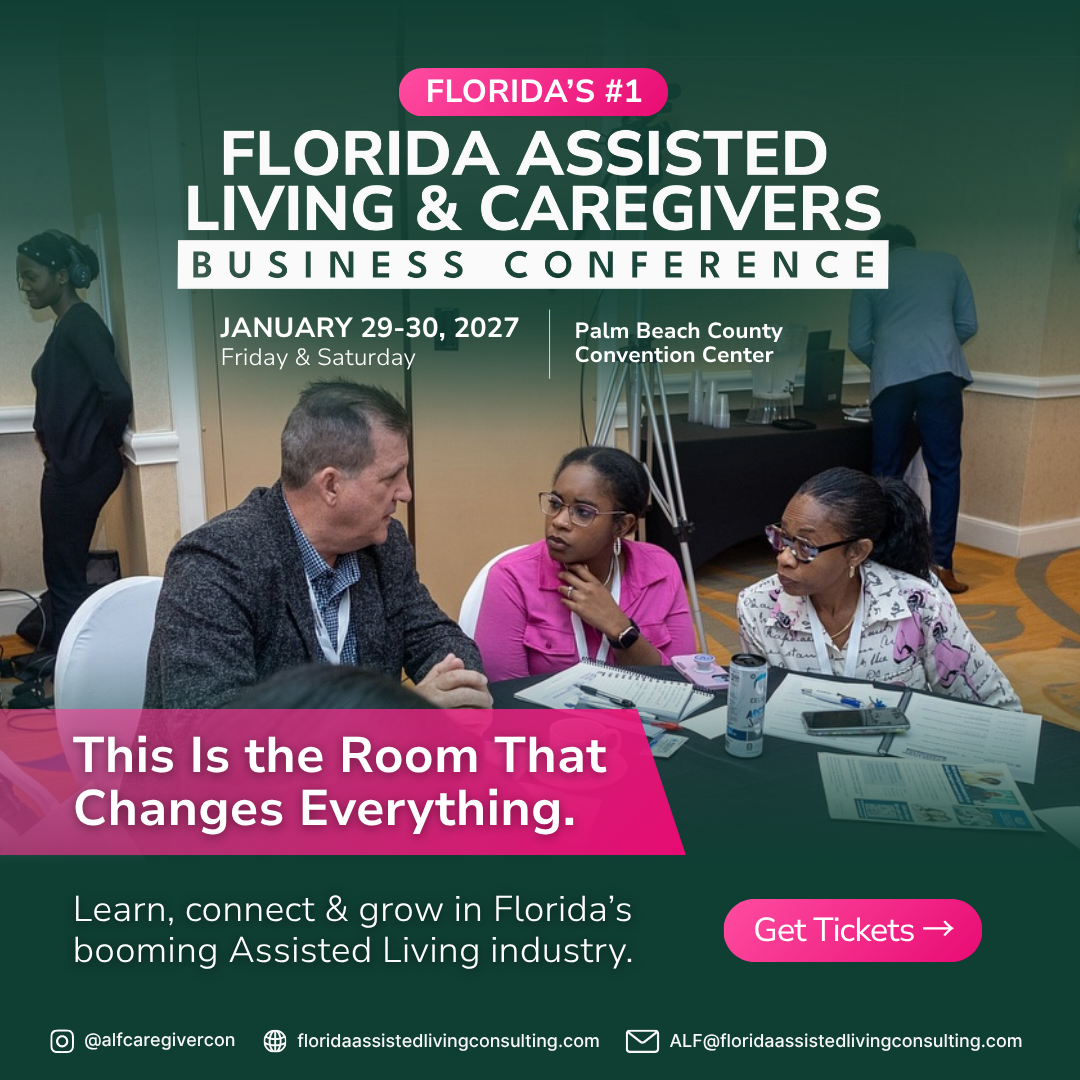
One of the Day One sessions at the ALF Caregivers Conference covers how to choose between these three licenses, and the licensing roadmap for each. Here's a piece of it now, because the wrong choice usually gets made before anyone buys a ticket.
Assisted living facility (ALF)
- Licensed by AHCA.
- No fixed statewide resident cap. Your real number is the smallest of what your zoning, parking and septic allow.
- The owner doesn't have to live there, or even live in Florida.
- Can add limited nursing, ECC and limited mental health licenses as you grow.
Adult family-care home (AFCH)
- Also licensed by AHCA.
- No more than five disabled adults or frail elders who are not relatives.
- The provider must own or rent the home and live there. If you don't plan to live in the building, this license isn't yours.
Group home licensed by the Agency for Persons with Disabilities (APD)
- A different agency and a different process entirely.
- At least 4 and no more than 15 residents.
- Serves people with a developmental disability, such as intellectual disability, cerebral palsy, autism, spina bifida or Down syndrome, that began before age 18.
One rule that applies to all three: for local zoning, Florida treats a licensed facility with six or fewer residents as a single-family residential use. At seven, it becomes a community residential home and goes through local siting review. One resident can change your entire zoning path.
That's the takeaway: pick the license before you pick the property. In the room, you get the full roadmap for each, plus a survey readiness keynote from AHCA's Kimberly R. Smoak, elder law for admissions with attorney Andrew Rosenberg, and panels on funding, filling beds, and fire, sprinklers and generators.
- Up to 9 Florida ALF continuing education hours with every ticket, for attending both days.
- Day three, the ALF CEO Implementation Mastermind, is capped at 25 people, separate registration.
- Both past conferences sold out completely, and tickets are moving fast. If you want to be in this room, don't wait until it's full to decide.
Get Your Ticket Now | Meet the Speakers
Before You Go
Save this email. Forward it to your administrator, or to a family member who's choosing a facility right now.
Get your conference ticket while seats are still open.
Take core training with me. The administrator is the one who decides whether a resident can stay, so that role has to be ready for it. Core training is 26 hours plus the state competency test, completed within 90 days of becoming administrator, and I'm an AHCA-approved ALF core trainer. Reply to this email with "Core Training" and our team will get you the details.
With prosperity,
Carline Cadet Francois
CEO, Florida Assisted Living Consulting LLC

Responses