

Your zoning letter says 12 beds.
You might only get 8.
Not because anyone lied to you. Because zoning is only one of the numbers that decides how many residents your building can hold. There are at least three more, and the smallest one wins.
Here's how to find every one of them before you make an offer, not after you close.
Number One: Zoning, and the Six-Resident Line
Under section 419.001 of the Florida Statutes:
- Six or fewer residents is treated as a single-family, noncommercial residential use for local zoning. It can go in a single-family or multifamily zone without local government approval.
- But there's a spacing rule even at six. It can't be within 1,000 feet of another existing home with six or fewer residents, or within 1,200 feet of an existing community residential home.
- Seven to fourteen residents makes it a community residential home, and that means local siting review. In a multifamily zone, the local government has 60 days to respond, and it can deny the site if it's within 1,200 feet of another community residential home or within 500 feet of single-family zoning.
- Above fourteen, you're outside the community residential home definition entirely, and your local code for larger facilities takes over.
Going from six residents to seven is not one more bed. It's a different zoning path.
Get It in Writing, and Read Every Line
A phone call to the planning department is a starting point, not an answer. The order is:
- Submit a zoning verification application for that exact address.
- Pay the fee.
- Get the written zoning confirmation letter.
- Put a zoning contingency in your contract.
The trap goes both ways. Someone calls, the city says yes, they buy, and the written verification comes back not permitted. By then it's their building.
And the reverse: in Lauderhill, one of our clients received a zoning letter that opened with "not a permitted use" and, two lines later, allowed the use as a Special Residential Facility, Category 1. Read the whole letter, not the first sentence. The city's word for your use is rarely your word.
Number Two: Parking
- Your local code sets the parking ratio for your use and zoning district.
- Run the arithmetic. If the requirement is 1.5 spaces per resident, 12 residents means 18 spaces. If the lot only holds 12 spaces, your number is 8.
- Count what the lot can actually hold, not what the listing says.
Number Three: Septic
- If the property isn't on sewer, septic capacity is rated per person, and that caps your residents. A system sized for a family is not sized for a facility.
- Plan for at least $12,000 in septic work on a six-resident building without sewer, before you know what the system can actually carry.
- Your county Health Department holds the property's septic records. Ask for them before you make an offer.
I break down septic versus city sewer in How to Choose the Right ALF Property in Florida.
Number Four: The Building Itself
- Bedrooms, bathrooms and square footage set their own ceiling under AHCA's physical plant requirements. Watch ALF Bedroom Size Requirements before you count beds on a floor plan.
- Whatever number you land on, plan for fire sprinkler and fire alarm from the very beginning. Someone will tell you otherwise. Your residents decide it, and retrofitting a licensed facility with residents inside is slower, costs far more, and can mean moving people out.
The Smallest Number Wins, and Here's the Good News
Picture one property:
- Zoning allows 12
- Bedrooms fit 10
- Parking supports 8
- Septic is rated for 8
Your real bed count is 8.
The good news: with room on the lot, parking can be added and septic can be increased, and both are far cheaper to plan before closing than after. More beds earn more, and the size you build for is decided before you buy, not after.
What to Do Before Your Next Offer
- Apply for written zoning verification on the exact address, and know which side of the six-resident line you're planning for.
- Map every licensed home within 1,200 feet, including AHCA-licensed facilities and homes licensed by other agencies, such as APD group homes.
- Get the parking requirement from your local code and count the spaces the lot can really hold.
- Request the septic records from the county Health Department if there's no sewer.
- Make sure your contract has a zoning contingency, and a due diligence period long enough for the city to send the written letter back.
This is the research my team runs for clients before they buy: the written verification, the distance check and the numbers that decide the real bed count. The information is yours either way. If you want it run on a specific address, that's what we do.
Watch This Week on YouTube
New videos go up every week on my channel, all free and all Florida-specific:
- Before You Buy Property for an ALF, Watch This: she put over $1.5 million into a West Palm Beach property to open a luxury ALF. Watch what happened next before you sign anything.
- AHCA Survey Citations: The 5 Florida ALFs Get Most Often
- Your ALF Occupancy Determines Everything
- Understanding Resident-to-Staff Ratios in Assisted Living Facilities
- The Biggest Mistakes New ALF Owners Make
Subscribe to the channel so the next one finds you.
From the Conference Program: The Contract Is Where Zoning Protection Lives
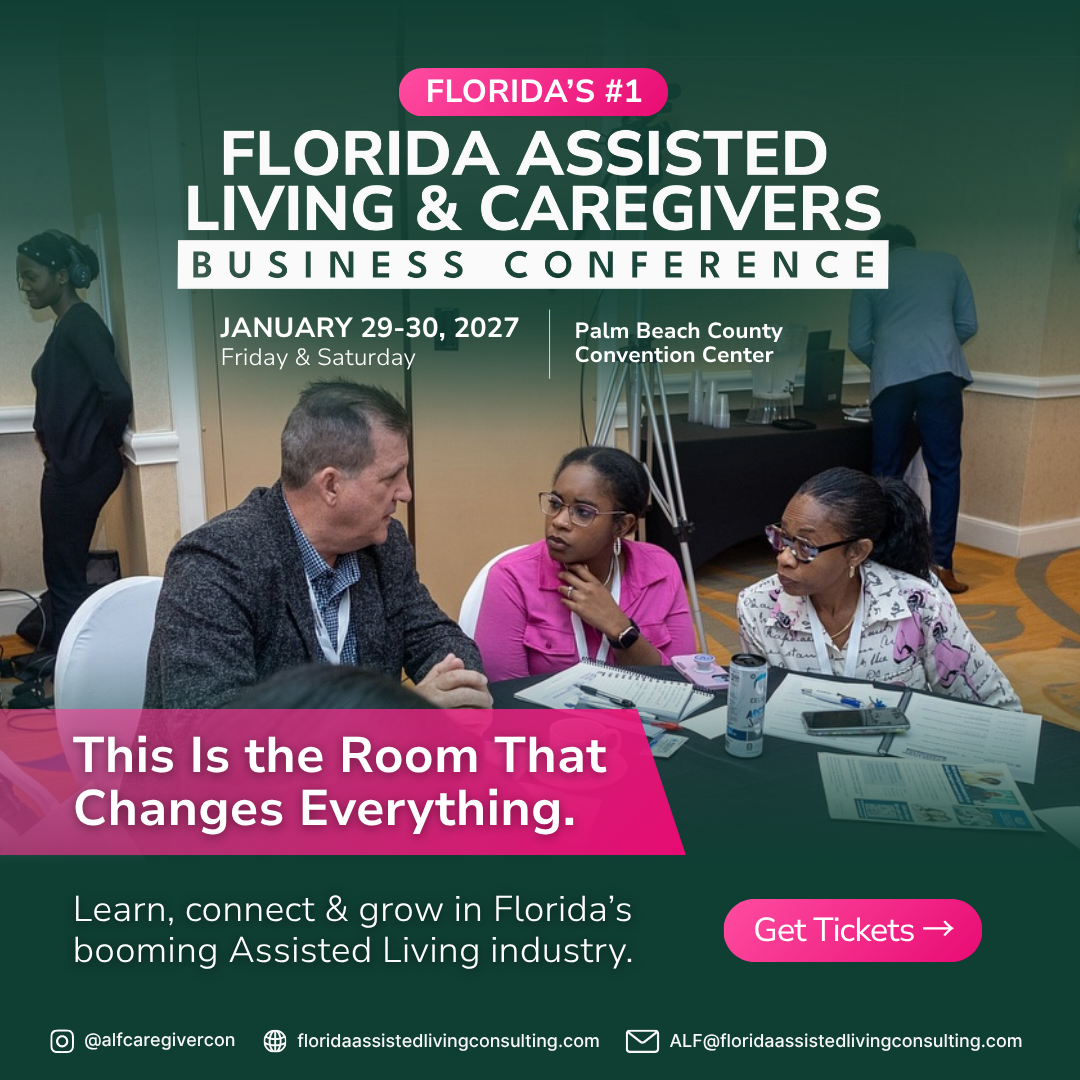
Day One of the ALF Caregivers Conference includes a real estate, zoning, legal and tax panel, with attorney Cristen Martinez of Martinez Law speaking on the contract stage and asset protection. Here's a piece of why it matters:
- A zoning letter protects you only if your contract lets you act on it. A zoning contingency is what lets you walk away if the written verification comes back "not permitted."
- Timing matters as much as wording. If your due diligence period ends before the city sends the letter, the contingency doesn't help you.
- Who owns the building and who holds the license is a decision, not a default. Many owners hold the real estate and the operating business separately. That's a conversation to have with your attorney before you sign, not after.
That's one panel. In the same two days: a survey readiness keynote from AHCA's Kimberly R. Smoak, elder law for admissions with attorney Andrew Rosenberg, and panels on funding, filling beds, and fire, sprinklers and generators.
- Up to 9 Florida ALF continuing education hours with every ticket, for attending both days.
- Day three, the ALF CEO Implementation Mastermind, is capped at 25 people, separate registration.
- Both past conferences sold out completely, and tickets are moving fast. If you want to be in this room, get your ticket before it's full.
Get Your Ticket Now | Meet the Speakers
Before You Go
Save this email, and forward it to your realtor before your next showing.
Get your conference ticket while seats are still open.
Take core training with me. Core training is 26 hours plus the state competency test, completed within 90 days of becoming administrator, and I'm an AHCA-approved ALF core trainer. Reply to this email with "Core Training" and my team will get you the details.
With prosperity,
Carline Cadet Francois
CEO, Florida Assisted Living Consulting LLC


Responses